
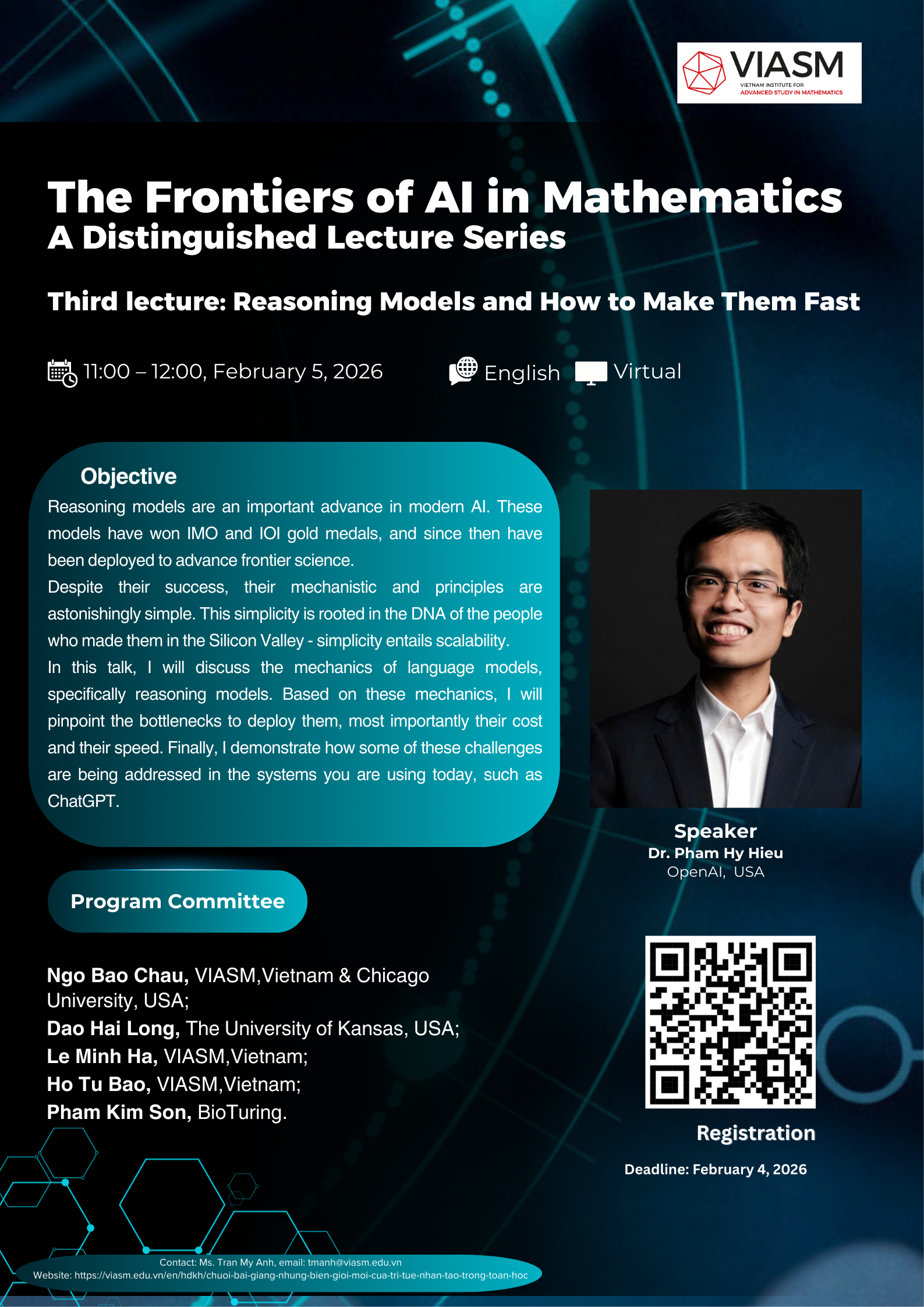
Time: 11:00-12:00, February 5, 2026
Mathematics has entered a new era. From automated theorem proving and conjecture generation to the discovery of hidden patterns in vast datasets, artificial intelligence is no longer merely a tool, it is becoming a collaborative partner in the creative act of mathematical discovery.
This series will bring together the leading experts who are reshaping the discipline. They will explore deep as well as practical questions: Can AI truly “understand” mathematics, or is it only recognizing patterns? How will proof assistants change the way theorems are discovered and verified? What are the limits and the dangers of machine-generated mathematics? How to use AI tools to improve the experience of doing mathematics for everyone, not just a few?
During this series of presentations, the audience will hear about the latest results, witness live experiments, and participate in current debate on the philosophical and practical implications of a future in which human intuition and machine computation are inextricably intertwined.
Whether you are a research mathematician, a computer scientist, a math enthusiast or simply fascinated by the evolving boundary between human and artificial reasoning, these talks offer an unparalleled view of mathematics at the dawn of its AI-augmented age.
The third lecture of the series will be given by Dr. Pham Hy Hieu, OpenAI, USA:
Title: Reasoning Models and How to Make Them Fast
Speaker: Dr. Pham Hy Hieu, OpenAI, USA.
Objective:
Reasoning models are an important advance in modern AI. These models have won IMO and IOI gold medals, and since then have been deployed to advance frontier science.
Despite their success, their mechanistic and principles are astonishingly simple. This simplicity is rooted in the DNA of the people who made them in the Silicon Valley - simplicity entails scalability.
In this talk, I will discuss the mechanics of language models, specifically reasoning models. Based on these mechanics, I will pinpoint the bottlenecks to deploy them, most importantly their cost and their speed. Finally, I demonstrate how some of these challenges are being addressed in the systems you are using today, such as ChatGPT.
Program Committee:
- Ngo Bao Chau, Vietnam Institute for Advanced Study in Mathematics;
- Dao Hai Long, The University of Kansas, USA;
- Le Minh Ha, Vietnam Institute for Advanced Study in Mathematics;
- Ho Tu Bao, Vietnam Institute for Advanced Study in Mathematics;
- Pham Kim Son, BioTuring.
Language: English
Format: Online
Join Zoom Meeting:
https://zoom.us/j/95741295390?pwd=BZ0f5ab4aixCTVWaWG193gWJphlf42.1
Meeting ID: 957 4129 5390
Passcode: 970893
Contact: Ms. Tran My Anh, email: tmanh@viasm.edu.vn
Registration: : https://forms.gle/itUqsnLcjinYiEEPA
Deadline: February 4, 2026