

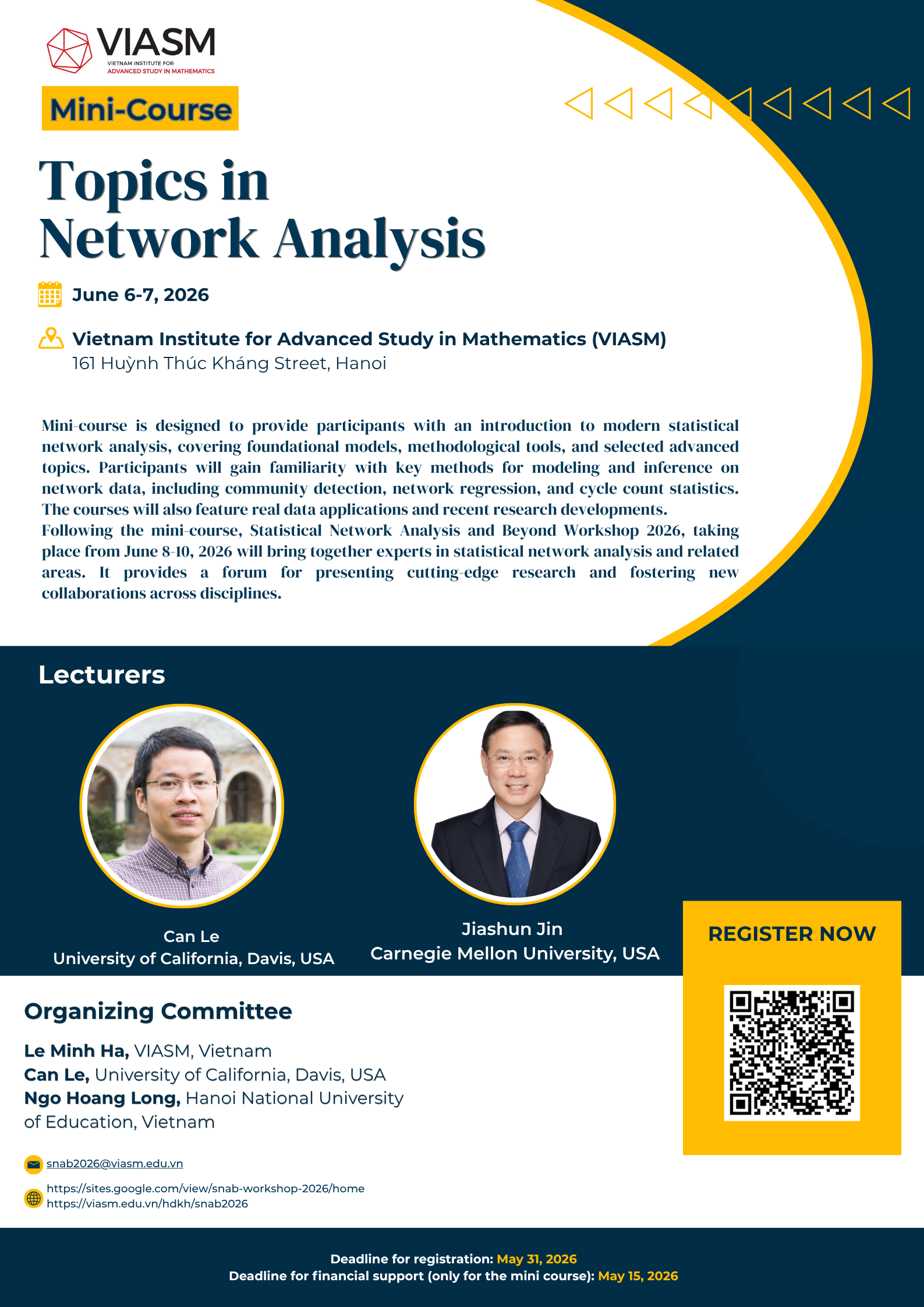
Date: June 6, 2026
Instructor: Can Le, Department of Statistics, University of California, Davis, USA
Title: Network Analysis: Models, Methods, and Inference
Abstract: This minicourse provides an introduction to statistical network analysis, emphasizing tools for modern inference on graphs. We begin by framing networks as data objects and surveying core inferential tasks. We then introduce important random graph models, including block models, mixed-membership extensions, and latent space models, highlighting how sparsity regimes shape both modeling and theory. Next, we discuss key methodological ideas, including spectral and variational approaches, that underpin many contemporary methods in network analysis. The day concludes with network-linked data analysis, focusing on regression models for node outcomes under network dependence and strategies for valid inference.
-----------------------------------------------------------------------------
Date: June 7, 2026
Instructor: Jiashun Jin, Department of Statistics, Carnegie Mellon University, USA
Title: Selected Topics in Network Analysis
Abstract: In the first two lectures, I will discuss two fundamental problems in network analysis: community detection and mixed-membership estimation. I will focus on the SCORE and Mixed-SCORE methods, but will also discuss some popular methods. I will also discuss a large-scale data set we collected and cleaned by ourselves, called the MADStat. MADStat consists of the bibtex and citation data of 83K papers published in 36 journals in statistics and related fields, spanning 41 years. The data set provides a rich data resource and can be used for network analysis, text analysis, and training large language models.
In the next two lectures, I will discuss the cycle count statistics. I will show how to use the statistics to address a few fundamental problems in network analysis, including but not limited to network global testing, network pairwise comparison, estimating the number of network communities, network goodness-of-fit, and estimating weak spikes in spiked models. I will also discuss how to compute the statistics, using a formula we discovered recently by combining the intelligence of human and AI.